Skip to content
the digital
dollhouse.
top of page
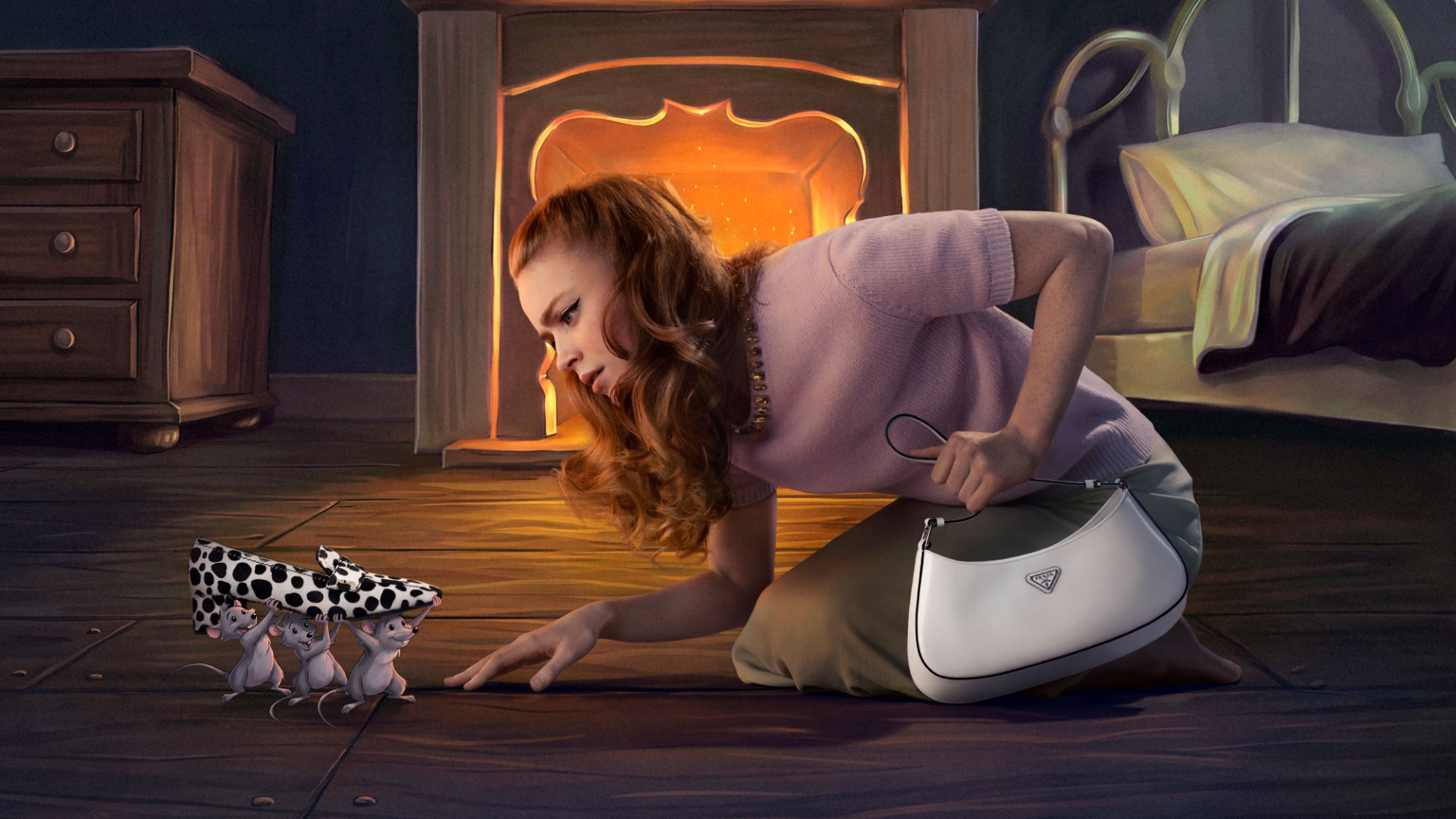
Prada Holiday 2026 campaign: model with white shoulder bag reaching towards illustrated mice carrying a spotted shoe.

Prada Picked Up a Pencil. What Should Beauty and Fashion Brands Do Next?

thedigitaldollhous
1 day ago
6 min read

Luxury has a curious new status symbol: evidence that a human being spent time making something. Not simply a polished finish. Not a perfect render. The visible choices, imperfections and imagination that make a piece of work feel authored rather than assembled.

On 27 October 2026, Prada launched Drawing Prada: Animated by Hand, a holiday campaign that places live-action actors inside a fantastical world of illustrated animals and winter scenery. It arrives at a moment when almost any brand can generate a spectacular-looking image in seconds. Prada's response is not to compete on speed. It is to make the method part of the message (Prada, 2026; Animation World Network, 2026).

The lesson for a growing skincare, fragrance, fashion or lifestyle label is not to abandon technology and hire a room full of animators. It is far more useful: choose a creative idea that only your brand could own, then pick the production technique that makes that idea feel true.

The cleverest thing in the Prada film is not the animation

The campaign features Sadie Sink, Maya Hawke, Chen Haoyu, Luther Ford and Kelvin Harrison Jr., photographed and directed by Glen Luchford. John Pomeroy leads the hand-drawn animation team. Real figures interact with curious foxes, mischievous mice and other illustrated creatures, with the lighting and perspective designed to make the two worlds belong together (Prada, 2026).

The distinction matters. This is not a brand buying a nostalgic filter. Prada has made craft itself a character in the story. The drawn environments echo the house's wider interest in materiality and making; the physical objects remain tangible while the setting becomes an impossible fairytale. The production method strengthens the positioning rather than decorating it.

There is a detail worth borrowing: the products have jobs in the narrative. A pair of loafers can be something a gang of mice wants to steal. A bag becomes an object of curiosity. A good product film doesn't have to recite features when it can make an object irresistible through story.

Why the human touch feels more valuable now

The economic story of creative technology is straightforward. More tools, more outputs, faster iterations. The cultural story is less convenient: if everyone can produce a plausible campaign image, plausibility stops being a differentiator.

In January 2026, IAB and Sonata Insights published research based on 505 US Gen Z and Millennial consumers and 104 US advertising executives. While 82% of executives assumed younger consumers felt positively about AI-created advertising, only 45% of surveyed consumers did. In the same study, 39% of Gen Z respondents expressed negative sentiment towards AI ads, compared with 20% of Millennials (IAB, 2026).

Those are US survey findings, not a UK market forecast, and they do not prove that audiences dislike every AI-assisted campaign. They do show why the industry should stop confusing 'we can make it' with 'people will want to watch it'. The IAB's own recommendation is to use AI to improve the creative outcome rather than treating lower production cost as the sole achievement.

When the tools are available to everyone, judgement becomes the scarce material.

The mistake would be turning this into 'human versus AI'

Prada's chosen craft is distinctive because it suits Prada's story. A playful niche makeup brand could feel equally authentic using stop-motion, practical effects, documentary-style creator footage or meticulously directed digital worlds. A futuristic fragrance launch might be better served by a striking impossible environment than by a hand-painted woodland.

Human-led does not mean technology-free. It means a creative director can answer why a shot exists, what the viewer should feel, which details need to remain physically accurate and where technical shortcuts would undermine the idea. Pre-visualisation, testing compositions and adapting approved assets for different placements can all benefit from new tools. None of that removes the need for taste, product knowledge and review.

The question is not 'Was AI used?' The better first question is 'Does the audience understand something distinctive about this brand because of what we made?' A second question follows: 'Can we stand behind what the work shows?'

Four decisions to make before the first frame

First, choose the emotional territory. Is your product about ritual, rebellion, comfort, transformation or the thrill of owning something beautifully made? Write one sentence about the feeling before you brief formats, software or talent.

Second, identify the truth that must survive production. In beauty, that could mean the exact shade, label, ingredients statement, packaging dimensions or an honestly represented product effect. Fantasy can surround a product without rewriting the product itself.

Third, decide what evidence of craft the audience should see. It might be the designer's sketches, a perfumer explaining an ingredient choice, a stylist's worktable, hands shaping a garment or a brief making-of sequence. Behind-the-scenes material is valuable when it reveals real decisions, not when it pretends an automated process was handcrafted.

Fourth, design a family of assets, not one lonely hero film. Agree the main idea, then plan a campaign film, product-first cut-downs, vertical edits, distinctive stills, clear landing-page creative and a considered organic rollout. The campaign should stay recognisable when cropped to nine by sixteen or reduced to a static feed card.

Three campaign concepts a smaller brand could actually test

THE TEXTURE TEST. For skincare or cosmetics, build a visual language around real material detail: the way a formula moves, light travels through a bottle or pigment sits on an approved surface. Combine tactile photography with art-directed motion. The hook is sensory, not an exaggerated claim about results.

THE OBJECT WITH A PAST. For a handbag, jewellery line or independent fashion label, turn a product into a small narrative protagonist. Show the design sketches, the choices that shaped it and a fictional story that gives it character. The audience remembers a world, while the product remains the hero.

TWO WORLDS, ONE PRODUCT. Pair a tangible, carefully photographed product with an unexpected illustrated or digitally built environment. The creative rule: the packaging, finish and shape stay true. Change the world, not the evidence. Use the contrast to introduce a collection or make a seasonal drop feel like an event.

Each route can start as a modest concept test. Produce a short proof of concept, show it to people who resemble the real buyer, and test whether they remember the brand and understand the offer. Scale the approach that earns attention for the right reason.

The compliance detail that beautiful moodboards tend to forget

For UK cosmetics advertising, the creative process cannot be separated from claims. CAP guidance explains that retouching and other production techniques must not misleadingly exaggerate a cosmetic product's achievable effect. The wider UK rules on misleading advertising also require objective claims to be substantiated (ASA/CAP, 2025; ASA/CAP, 2026).

This doesn't mean imaginative advertising is banned. It means brands need to distinguish a clearly fantastical world from a demonstration that appears to prove an actual product benefit. A made-up snowstorm around a faithfully represented lipstick is very different from creating an unsupported before-and-after skin result. Review the final asset, not just the prompt or storyboard.

Measure the idea, not the amount of content

There is no trophy for producing fifty edits that all say the same thing. Set a job for every creative asset. The hero film might be designed for distinctive reach and recall. A product demonstration might answer objections. A cut-down might earn a click. The landing page must then do the unglamorous work of making the next step obvious.

For a proper test, compare a coherent campaign route against the existing creative on the same audience, placement and timeframe where possible. Look beyond views to qualified site visits, add-to-cart behaviour, enquiry quality or assisted conversions. Where budget allows, test brand recall and purchase consideration too. Do not attribute a sales uplift to the aesthetics alone without a credible comparison.

The campaign that wins will not necessarily be the one that looks the most expensive, the most analogue or the most futuristic. It will be the one that makes the right people care, understand and act.

The next luxury isn't anti-technology. It's intention.

Prada's holiday campaign is beautiful because the medium and the meaning agree. That is the part a beauty or fashion founder can afford to borrow, even without Prada's production budget. Start with a point of view. Protect the truth of the product. Make creative choices that deserve attention. Then use whatever production tools help bring that vision to life.

At The Digital Dollhouse, we approach campaigns through concept, direction and careful production, combining creative judgement with modern technology. If your next launch needs a world worth entering rather than another scroll-past asset, start with the brief. The tools come later.

Sources and further reading


Recent Posts

See All

Comments


Commenting on this post isn't available anymore. Contact the site owner for more info.

Step Into the Dollhouse 

Collabs

For PR and commercial enquiries please contact: 

hello@thedigitaldollhouse.co.uk

Contact us

Knock, knock! The dollhouse door is open ✳ We reply within 1 working day

What can we help with? (optional)
Approximate budget (optional)

© 2026 The Digital Dollhouse. Knutsford.

bottom of page