Skip to content
the digital
dollhouse.
top of page

How to Sell Perfume Online in 2026: 7 Fragrance Marketing Ideas That Actually Make Sense

thedigitaldollhous
1 day ago
11 min read

The psychology of scent, the rise of fragrance layering, and why the most interesting beauty campaigns sell a feeling before they sell a bottle.

By The Digital Dollhouse | 1 November 2026 | Beauty, fragrance and creative strategy

Imagine trying to sell a song with the sound switched off.

Now imagine trying to sell a fragrance through a screen that has never, in the history of smartphones, successfully transmitted a smell.

Welcome to perfume marketing.

You can photograph the bottle. You can make the lighting impossibly beautiful. You can describe the fragrance using an elaborate collection of French adjectives.

But there is still one tiny problem.


Nobody can smell your advert.

And in 2026, that problem is one of the most interesting creative challenges in the beauty industry.

According to the Mintel UK Fragrances Market Report 2026, the UK fragrance market is estimated at £1.7 billion in 2026. Yet 69% of UK adults who buy the fragrances they use say purchasing a new fragrance online without trying it feels risky (Mintel, 2026).

That is a remarkable contradiction. We can discover almost anything through a phone, but fragrance remains stubbornly physical.

The question for brands is no longer simply, How do we make this perfume look expensive?

It's How do we make somebody want something they cannot experience yet?

The answer sits somewhere between psychology, cinema, creative strategy, useful digital experiences and knowing the customer extraordinarily well.

1. Stop selling perfume notes. Start selling memories.

Picture two fragrance adverts.

In the first, a perfectly lit bottle rotates against a marble background. Text appears: Bergamot. Amber. Musk. Lovely. Very professional. We've learnt three ingredients.

Now picture the second.

A hotel room at 2:14am. A velvet jacket abandoned over a chair. Rain moving across a window. Someone has just left, but the room still feels occupied.

A bottle appears. Some things stay.

Which one made you feel something?

This is the difference between product description and sensory storytelling.

Researchers have studied how smell relates to emotional memory for decades. In a study in Chemical Senses, Rachel Herz found that autobiographical memories evoked by actual odours were more emotional and evocative than memories prompted by equivalent visual or auditory cues (Herz, 2004).

That does not mean a film can reproduce the effect of smelling a real fragrance. It cannot. But it is a useful reminder that fragrance belongs to a deeply personal emotional category.

A scent can remind someone of a grandparent's house, their first holiday abroad, a particular person or an evening they wish had lasted longer.

Good fragrance advertising can build a memorable story around that territory.

A body mist might represent a spontaneous summer. A niche perfume might evoke an intimate late-night conversation. A home fragrance might suggest the quiet ritual of closing the door after a long day, without making unsupported wellbeing claims.


The creative question: Instead of asking only what ingredients your fragrance contains, ask what sort of moment you want it to belong to. Then make that moment unforgettable.

2. Use colour, texture and light to make an invisible product imaginable.

Can you tell me exactly what amber smells like?

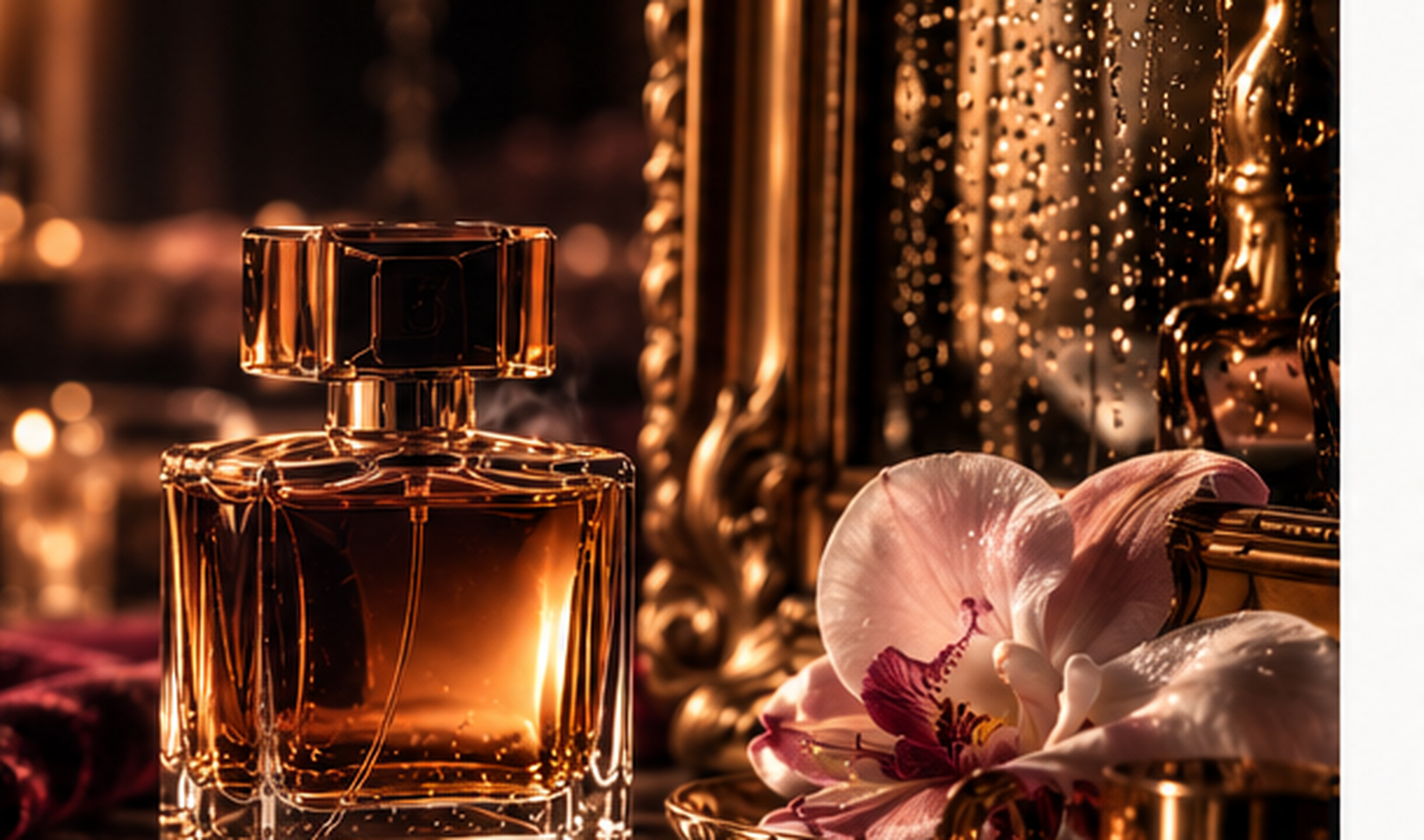
Probably not. But show someone warm golden light, polished wood, heavy velvet and dark glass, and they may start imagining something rich and enveloping.

Switch to pale blue light, translucent fabric, water droplets and frosted glass. The emotional expectation changes.

This is the science of cross-sensory associations meeting the art of visual direction.

Schifferstein and Tanudjaja (2004) found that people made non-random associations between fragrances and colours, with emotional impressions explaining part of the relationship.

Here is the important caveat. A later study by Schifferstein and Howell (2015) found that matching packaging colours to fragrances did not, on its own, improve buying intentions. Participants' liking for the fragrance and its packaging mattered more.


Beautiful visuals cannot rescue a product people don't like. They can, however, create an expectation of its personality.

Think macro photography of silk for softness. Sharp reflections and cool metal for a contemporary edge. Warm skin tones and low lighting for intimacy. Slow-moving fabric for calm, or a sudden splash of water for energy.

Motion, framing and editing matter as much as colour. A lingering close-up communicates something different from a frenetic sequence of cuts.

None of these choices conveys exactly how the perfume smells. Together, they can give an otherwise invisible product an unmistakable visual identity.

The most interesting fragrance campaigns do not merely have a look. They have an atmosphere.

3. Make the cinematic advert. Let real customers tell the truth.

A stunning campaign may make somebody fall in love with a fragrance. A genuinely useful customer review may be what convinces them to try it.

Those are different jobs, and brands need both.

TikTok's What's Next 2026 report argues that audiences increasingly value real people, honest processes and behind-the-scenes stories alongside polished work (TikTok, 2026). That is TikTok's own platform analysis, not a universal law about every consumer.

Separate research from sampling platform SoPost offers another signal. Its 2026 SoPost and UNiDAYS Sample Society findings reported that 43% of the Gen Z members surveyed identified peer-review videos as their primary purchase influence (Hardy, 2026).

This was research from an engaged sampling community, not a nationally representative measure of all Gen Z shoppers. It nevertheless highlights a credible audience-specific opportunity: real product experiences can be important in buying decisions.


The first job is the dream: a cinematic film with original creative direction, a recognisable aesthetic and an idea worth remembering.


The second is the proof: a genuine creator or customer trying the perfume, explaining their personal impression, describing when they wear it and sharing honest feedback.

One can build desire. The other can reduce uncertainty.

The mistake is treating artistic advertising and authentic content as competitors. They are complementary parts of the same customer journey.

After the film, the viewer should be able to find accurate product details, real reviews and, where available, a practical route to sampling.

Because beautiful advertising can start a conversation. Trust helps carry it forward.

4. Build campaigns around fragrance wardrobes, not just one signature scent.

Remember the idea that everyone should have one signature perfume? One unmistakable scent. One bottle on the dressing table. One lifelong fragrance identity.

That idea is becoming more flexible for many enthusiasts.

Pinterest Predicts 2026 identified Scent Stacking as a rising interest. Pinterest reported increases in normalised search activity of 125% for 'perfume layering combinations', 500% for 'niche perfume collection', and 80% for 'perfume notes' (Pinterest, 2025).

Those percentages describe changes in Pinterest searches over the platform's specified historical comparison periods. They do not mean perfume sales increased by those amounts.

A 2026 industry report highlighted by CEW UK similarly describes consumers building personal scent systems for different moods, functions and occasions rather than relying solely on one signature fragrance (CEW UK, 2026).

For brands, the storytelling possibilities are huge.

The fragrance for the early train. The fragrance for the last train. The one you wear when you want to disappear. The one you wear when you absolutely do not.

A brand might develop editorial content around discovery sets, fragrance wardrobes, routines and layering combinations it has actually tested.

The opportunity is not simply to push people to buy more bottles. It is to make discovery more personal, informative and engaging.

5. Make your campaign searchable long after the social post disappears.

Imagine producing the most beautiful fragrance advert of the year.

You post it once. People watch it. Then what?

A campaign should have somewhere useful to send people, and a life beyond one feed.

Some customers search for inspiration. Others need practical answers before buying. Someone might be researching the difference between eau de parfum and eau de toilette, while somebody else wants to know how perfume layering actually works.

These are different questions and deserve different content.

A fragrance brand could create genuinely useful articles such as What does amber smell like in perfume?, How do you choose a perfume online without smelling it?, What is fragrance layering?, How can you build a fragrance wardrobe?, or What's the difference between eau de parfum and eau de toilette?

But a winning search strategy is not stuffing those questions into one page. It is matching helpful answers with the searcher's intention, documenting your expertise and linking related subjects sensibly.

For example, a layering article could explain the concept, show combinations the brand has actually tested, use accurate product images and connect readers to relevant sampling or product information.

A single original campaign idea can inform a Journal feature, a Pinterest visual, a short educational video, a product FAQ and a genuinely useful email to consenting subscribers.


Good creative attracts attention. Good digital strategy gives that attention somewhere to go.

6. Treat the product page as part of the creative, not the boring bit afterwards.

Here's a statistic that should interrupt every luxury brand moodboard.

A YouGov survey of 800 GB adults, conducted on 14 October 2025, found that among respondents who used perfume, 86% selected the scent itself as a key purchase influence. For discovery, 63% reported sampling in-store, compared with 9% selecting social media or influencers (Bali, 2025).

These were survey responses, not evidence that social media can never work. They do remind us that trying the fragrance remains important for many people.

Digital campaigns should make real-world product experience easier, not pretend to replace it.

Does the product page explain the fragrance clearly? Can the customer identify the size, price and delivery details? Are bottle and packaging images accurate? Can they find an authentic review? Can they obtain a sample or discovery set, if the brand offers one? Does the mobile journey actually work?

A beautiful campaign followed by a confusing checkout is like inviting someone to a gorgeous boutique and then hiding the till.

The film, photography, copy, ecommerce design and customer journey need to feel connected.

When brands collect personal information for personalisation, reviews, remarketing or email, they also need to comply with applicable privacy and marketing rules. A lovely campaign does not excuse a poor customer experience.

7. Be daring, but never let the creative misrepresent the product.

Digital production makes extraordinary visual treatments possible. Light can move in impossible ways. Fabric can become a landscape. An everyday perfume bottle can inhabit an otherworldly set.

But there is an important difference between visual metaphor and misleading product information.

A golden cloud of light surrounding a bottle can communicate an atmosphere. Claiming a fragrance lasts 48 hours, improves sleep or produces a measurable physiological effect is an objective claim that needs appropriate substantiation.

The Advertising Standards Authority explains that UK marketing communications must not materially mislead consumers; applicable advertising rules require adequate evidence for objective claims (ASA, 2026).

Product depictions should accurately represent the item being sold. Brands also need rights and permissions for footage, music, talent, locations, artwork and third-party material.

At The Digital Dollhouse, our point of view is straightforward: human-led creative direction, technology-enabled production. The idea comes first. We choose practical photography, design, digital techniques or a considered combination to serve that idea, not to make a spectacle of the tools.

The goal is not to make people wonder how many effects were used. It's to make them remember the story.

Inside the Creative Lab: THE LAST WARMTH

So what might this approach look like in practice?

For our November Creative Lab exploration, we have developed THE LAST WARMTH, an original, self-initiated concept for a fictional, unbranded fragrance. It is a creative treatment in development, not a completed film or a commissioned client campaign.

The idea begins with an empty room.

A hand has just lifted from velvet. Condensation slowly disappears from a mirror. A curtain moves, although nobody is standing beside it. A narrow line of amber light travels across the furniture.

Everything suggests that someone has recently been there. But we never see them.

Only at the end would the fragrance bottle appear.

What stays after you go.

The treatment explores presence through absence. Texture, movement and light create an emotional world around an invisible product.

We wanted to ask a deceptively simple question: What if a fragrance advert showed everything except the person wearing it?

It's one possible answer to the challenge facing the category. Not by pretending a screen can reproduce scent, but by making someone curious enough to experience it themselves.

Three jobs every fragrance campaign needs to do


Create emotion. Give the audience a reason to care about the brand and a story worth remembering.


Build understanding. Help people imagine the fragrance's character while explaining the actual product accurately.


Make trial possible. Provide a credible route from curiosity to experience and from experience to a confident purchase, whether through sampling, a discovery set or an in-person retailer.

A campaign that creates emotion but no confidence can leave customers uncertain. A product page that only lists ingredients can struggle to create desire. And a brand investing in beautiful assets without considering the path to purchase may be missing the point.

The exciting work happens when all three come together.

Frequently asked questions about fragrance marketing

How do you advertise perfume online when customers cannot smell it?

Combine sensory storytelling with accurate descriptions, genuine customer experiences and an accessible opportunity to sample where available. Visual advertising can establish a fragrance's character and identity, but it cannot reproduce the actual scent.

What is the most effective marketing strategy for a perfume brand?

There is no universal strategy. It depends on the customer, price, positioning, distribution and budget. Start with a distinctive identity, helpful information, authentic reviews, a well-functioning online store and ways to reduce the risk of buying without trial.

Is TikTok useful for fragrance marketing?

It can be useful for discovery, education and creator-led storytelling, especially when the audience uses the platform. But views do not automatically become sales. Measure the quality of visits, product interest, sampling uptake and eventual purchasing behaviour.

How can a new perfume brand stand out from established competitors?

Start with a clear point of view and an audience you can serve well. Instead of reproducing somebody else's luxury campaign, build your own product positioning, creative idea, distinctive visual identity and customer experience.

Does perfume marketing require expensive video production?

Not always. The right investment depends on the idea and channels. An excellent original still-life, an authentic review and a carefully designed product page can each be valuable. Spend where the creative approach and customer needs justify it.

The future of fragrance advertising is something you can feel.

A beautiful bottle will always matter. So will fragrance notes, elegant packaging and carefully considered photography.

But the best campaigns give people something bigger than a product to connect with.

A feeling. A memory. A story. A moment.

Something that stays.


And that might be the most powerful thing a fragrance brand can offer before the first spray.

Have a beauty or fragrance brand that deserves a more interesting campaign?

The Digital Dollhouse is a Knutsford-based digital marketing and creative technology studio working with brands across the UK. We create distinctive advertising campaigns, brand and social content, digital marketing strategies, websites and custom apps.

From the big idea to the experience customers have after discovering a brand, we think every touchpoint should work together.


THE DIGITAL DOLLHOUSE. A creative department without the production overhead.


For enquiries: hello@thedigitaldollhouse.co.uk

References (Harvard style)

Advertising Standards Authority (ASA) (2026) Misleading advertising. Available at: https://www.asa.org.uk/resource/misleading-advertising.html (Accessed: 1 November 2026).

Bali, S. (2025) 'Scent first, brand later: How Britons buy their perfume', YouGov, 20 October. Available at: https://yougov.com/en-gb/articles/53212-scent-first-brand-later-how-britons-buy-their-perfume (Accessed: 1 November 2026).

CEW UK (2026) 'The Fragrance Futures Index 2026 by TFS x CPL Aromas', 29 May. Available at: https://cewuk.co.uk/the-fragrance-futures-index-2026-by-tfs-x-cpl-aromas/ (Accessed: 1 November 2026).

Hardy, E. (2026) '74% of UK Gen Z would spend £100+ on fragrance. Are beauty brands underestimating their spending power?', SoPost, October. Available at: https://sopost.com/blog/sopost-unidays-gen-z-data/ (Accessed: 1 November 2026).

Herz, R.S. (2004) 'A naturalistic analysis of autobiographical memories triggered by olfactory visual and auditory stimuli', Chemical Senses, 29(3), pp. 217–224. Available at: https://doi.org/10.1093/chemse/bjh025 (Accessed: 1 November 2026).

Mintel (2026) UK Fragrances Market Report 2026. Available at: https://store.mintel.com/report/uk-fragrances-market-report (Accessed: 1 November 2026).

Pinterest (2025) 'Pinterest Predicts: Nonconformity, self-preservation, and escapism drive 21 trends for 2026', Pinterest Newsroom, 9 December. Available at: https://newsroom.pinterest.com/en-gb/news/pinterest-predicts-nonconformity-self-preservation-and-escapism-drive-21-trends-for-2026/ (Accessed: 1 November 2026).

Schifferstein, H.N.J. and Howell, B.F. (2015) 'Using color–odor correspondences for fragrance packaging design', Food Quality and Preference, 46, pp. 17–25. Available at: https://doi.org/10.1016/j.foodqual.2015.06.012 (Accessed: 1 November 2026).

Schifferstein, H.N.J. and Tanudjaja, I. (2004) 'Visualising fragrances through colours: the mediating role of emotions', Perception, 33(10), pp. 1249–1266. Available at: https://doi.org/10.1068/p5132 (Accessed: 1 November 2026).

TikTok (2026) What's Next 2026 Trend Report. Available at: https://ads.tiktok.com/business/en-GB/next (Accessed: 1 November 2026).

Recent Posts

See All

Comments


Commenting on this post isn't available anymore. Contact the site owner for more info.

Step Into the Dollhouse 

Collabs

For PR and commercial enquiries please contact: 

hello@thedigitaldollhouse.co.uk

Contact us

Knock, knock! The dollhouse door is open ✳ We reply within 1 working day

What can we help with? (optional)
Approximate budget (optional)

© 2026 The Digital Dollhouse. Knutsford.

bottom of page